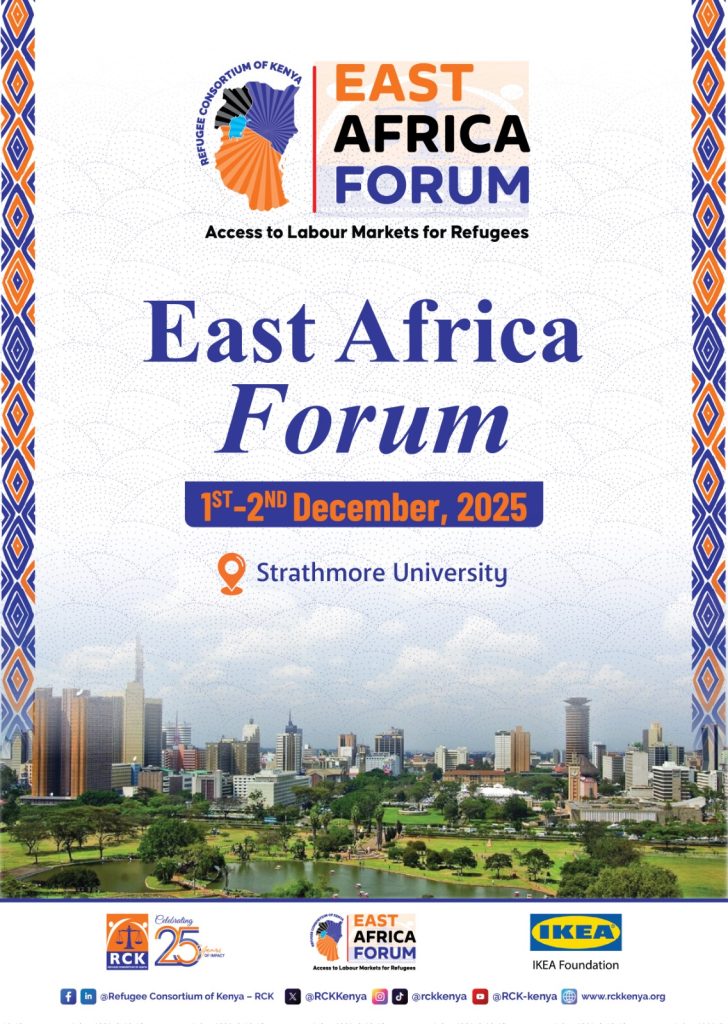
On the 1st and 2nd of December 2025, the Refugee Consortium of Kenya (RCK), in partnership with the IKEA Foundation, convened a landmark gathering at Strathmore University, Nairobi. The inaugural East African Regional Forum on Access to Labour Markets for Refugees marked a pivotal moment for the region. Organized under the Wezesha project, which was designed to create an enabling environment for refugees and host communities in Kenya to achieve social rights and economic self-reliance. The forum brought together a diverse cross-section of voices, including representatives from government ministries, regional bodies (EAC, and IGAD), UN agencies, development partners, academia, civil society, the private sector, and most importantly, refugee-led organizations from across Kenya, Uganda, Tanzania, and South Sudan
This convening took place at a time of shifting global humanitarian financing, protracted displacement crises across the Horn of Africa, and a growing consensus that the inclusion of refugees in national labour markets is not merely a matter of charity, but a fundamental development imperative and a shared regional responsibility.
For decades, the region’s response to displacement has been shaped by a humanitarian model, largely delivered through parallel systems centered in camps. While this approach addressed immediate protection needs, it inadvertently limited long-term autonomy and economic participation. With funding streams shrinking and displacement becoming a prolonged reality, the status quo is no longer viable. The Forum was therefore conceived as a platform to accelerate the transition toward sustainable, government-led inclusion frameworks that recognize refugees as potential contributors to host economies, rather than passive recipients of aid.
The Wezesha project designed the Forum with a clear focus: to build upon existing evidence and dialogue, adding value without duplicating efforts. The core objectives were to strengthen sustained regional coordination, enhance mutual accountability among stakeholders, and, most critically, to identify practical and implementable pathways to improve refugees’ access to decent work. Grounded in the comparative experiences of Kenya, Uganda, South Sudan, and Tanzania, the discussions sought to bridge the persistent gap between progressive policy commitments and the often-fraught operational realities on the ground.
Progress, Paradoxes, and Persistent Barriers
The conference acknowledged the significant strides East African states have made. Kenya’s implementation of the progressive Refugees Act, 2021 and the Shirika Plan signal a decisive shift toward integrating refugee services into national systems. Uganda’s long-standing self-reliance model continues to offer valuable lessons in facilitating freedom of movement and the right to work. Across the region, increased engagement through EAC and IGAD frameworks points to a growing political will to harmonize migration governance and labour mobility.
However, the Forum also served as a crucial reality check, highlighting the structural barriers that stubbornly persist. A key concern was the fragmentation of refugee labour policies. Divergent national approaches to documentation, mobility, and work authorization have created a patchwork system that complicates cross-border planning and undermines the very regional economic integration these bodies seek to achieve. Even where laws are progressive, inconsistent implementation across different government agencies often creates confusion for refugees and potential employers, stifling opportunity before it can take root.
Documentation emerged as the single most critical barrier. As governments transition from parallel systems to integrated national service delivery, possessing valid identity documents and work permits is no longer optional—it is the gateway to employment, financial services, education, and social protection. Yet, persistent delays in issuance, limited decentralization of services, and a lack of clarity on the recognition of refugee credentials continue to exclude large numbers from the formal economy. This exclusion confines them to precarious, informal work, heightening their vulnerability to exploitation and abuse.
A Disproportionate Impact and the Promise of Inclusion
Discussions underscored that these barriers are not felt equally. Refugee women and youth face compounded challenges. Women-headed households, survivors of gender-based violence, and young people transitioning from education to employment encounter limited access to finance, unpaid care responsibilities, and workplace discrimination. A clear consensus emerged: labour market inclusion strategies must be deliberately gender-responsive and shaped by the lived realities of refugee communities. This means integrating childcare support, safeguarding mechanisms, flexible training, and targeted financial inclusion into every aspect of programming.
The Forum also grappled with the complexities of onward and cross-border movements. Refugee populations are dynamic, and uncoordinated secondary movements between countries complicate national planning. It was agreed that these movements cannot be managed through isolated national policies. Strengthened regional coordination, harmonized documentation standards, and robust information-sharing are essential for a coherent and predictable response.
Amidst these challenges, the Forum also shone light on promising practices. Examples from Uganda demonstrated how refugees, when supported by an enabling environment, establish thriving enterprises, join savings groups, and invigorate local economies. In Kenya, the Shirika Plan was recognized as a critical opportunity to embed refugee inclusion within national development frameworks. Refugee-led organizations and private sector actors showcased scalable models that combine skills training, entrepreneurship incubation, and market linkages.
A recurring theme was the need to move from “textbook” policy design to evidence-based implementation. Participants stressed the urgent requirement for robust, disaggregated labour market data to guide programming, engage the private sector meaningfully, and measure progress toward self-reliance. Without reliable data on refugee skills and workforce participation, interventions risk being misaligned with actual needs and market demands.
A Collective Roadmap for Action
Building on this rich dialogue, RCK facilitated a collaborative co-creation session on the second day, designed to forge a tangible regional roadmap for action. Stakeholders collectively identified priority areas, including:
- Necessity to harmonize policies to advance a common regional approach for refugee labour market inclusion through EAC and IGAD framework.
- Digitize and streamline documentation systems to enhance the accessibility and cross-border recognition of refugee identities and work authorizations.
- Strengthen inter-agency coordination to foster more effective collaboration between national ministries, regional bodies, and civil society.
- Establish mechanisms for the recognition of prior learning to formally validate the qualifications and skills that refugees bring with them.
- Create structured public-private partnership platforms to strategically engage the private sector as a key partner in employment and training.
- Strengthen labour protection mechanisms to safeguard all workers, including refugees, from exploitation and abuse.
- Establish a regional monitoring and accountability platform to track progress, measure impact, and ensure follow-through against shared goals.
This roadmap outlines concrete actions to be pursued within the next 1 – 2 years, assigning clear responsibilities across relevant ministries, regional bodies, civil society, and development partners.
Conclusion: A Shared Ambition
The Forum concluded with a powerful and unified consensus that refugee labour market inclusion is no longer an option but a central pillar of country-based and regional stability, economic growth, and social cohesion. Refugees should be recognized as economic actors and contributors. However, inclusion must be managed in a way that also strengthens host communities, preventing social tensions and ensuring that the benefits are shared by all.
No single institution or government can navigate this transition alone. Sustained collaboration, political will, and coordinated regional action are indispensable. As the convener, RCK remains deeply committed to advancing the outcomes of this Forum. We will work with partners to support follow-up engagements, operationalize the agreed roadmap, and track progress through measurable indicators.
The East African Regional Forum on Access to Labour Markets for Refugees reaffirmed a shared regional ambition to build resilient systems that enable refugees and host communities to thrive together. As humanitarian resources/ shrinking funding decline and displacement endures, the path forward is clear. It lies in coordinated, development-oriented approaches that unlock the productive potential of all who reside within our region, building a more prosperous and inclusive future for East Africa.